

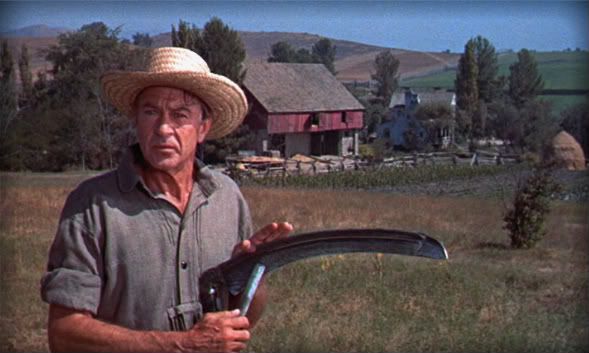
Friendly Persuasion (1956), a William Wyler movie based on The Friendly Persuasion, a collection of short stories by the writer, Jessamyn West, who was of Quaker descent, starred Gary Cooper, Dorothy McGuire, Anthony Perkins and the great Marjorie Main in a small role. The film, which is available on DVD, is being broadcast on TCM on January 15, 2011 at 3:00 AM ET.
It is a simple story. A 19th century Quaker family squabbles over the encroachment of the outside world on their idyllic rural lives. A forbidden horse race disturbs the peace of the Sabbath, a Quaker meeting interrupted by news of approaching armies, a county fair with all its temptations takes place, a new courtship begins for young lovers and a renewed one for a married couple, a young man looks for the strength within himself to choose the right path in his life, and life and death inevitably intrudes on our reverie. The themes of love, death, honor and human foibles are eternal.
I am drawn to the way that the movie recreates a bucolic rural world of an Indiana farm in the 1860s that seems to echo the images of Winslow Homer, N.C. Wyeth, and Tasha Tudor paintings. The soft color and beautifully detailed touches in the world inhabited by a Quaker family, the Birdwells, created by Jessamyn West and based on her own family. Filmed at the Rowland V. Lee ranch in the San Fernando Valley, are rendered so well thanks in part to the color cinematography of Ellsworth Fredericks and Ted Haworth's art direction. Initially, William Wyler's first film in color may seem to be a sunny, even smug paean to a utopian America that never existed.
That is the superficial view that has led some contemporary critics, such as David Thomson, to dismiss the film as "one of the dreariest pictures [Gary] Cooper ever made." Thomson and others reject what they regard as "pieties" in the story that they may believe earn "respectability and serious themes a crushing reputation," despite six Oscar nominations and winning the Palme d'Or at the Cannes Film Festival. Sadly, despite the generally good reviews at the time of the movie's release Friendly Persuasion, which had been budgeted as $2 million, but ultimately cost over $4 million, the movie was a disaster for Allied Artists, affecting the indie production unit's ability to make and market future films.
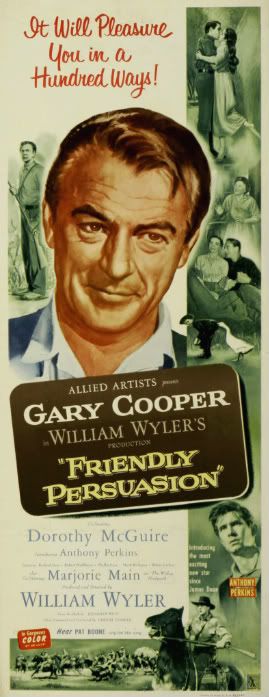
Friendly Persuasion does presents a rustic world punctuated by familial comedy in the first part of the film. As it follows a Quaker family's philosophical and emotional journey through the Civil War and the challenges it presents to each family member, the film darkens. As a commercial production with a desire to draw in an audience, Wyler and his collaborators included a treacly theme song sung by one of the era's heart throbs, Pat Boone, called "Thee I Love" with lyrics by Paul Francis Webster and music by Dmitri Tiomkin.* In the same era as The Wild One and Rebel Without a Cause as they grapple with keeping their love alive against the background of teen angst experienced by Anthony Perkins and Phyllis Love as the family teenagers, and leavened by the childhood antics of Richard Eyer's put-upon Little Jess. Eventually, the more thoughtful aspects of the film focusing on the three main character's depth of religious belief, the threat posed to the family unit by the outside world (a theme that Wyler had explored in his previous film set in 1955, The Desperate Hours), and the strains that imposed on their love for one another, their home and their individual consciences. As he had done in in The Best Years of Our Lives (1946) and The Little Foxes (1941), Wyler composed scenes beautifully, with action occurring in the foreground and sides of the screen, as well as in the distance.
 |
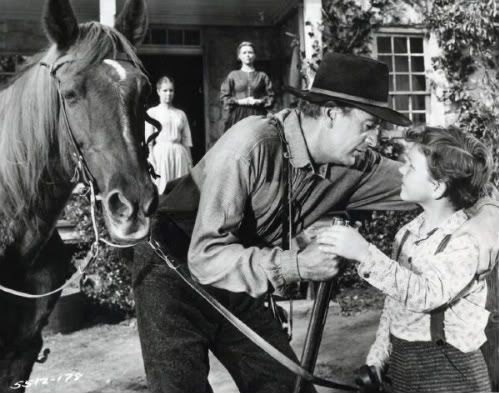
| Gary Cooper with Richard Eyer in Friendly Persuasion (1956). |
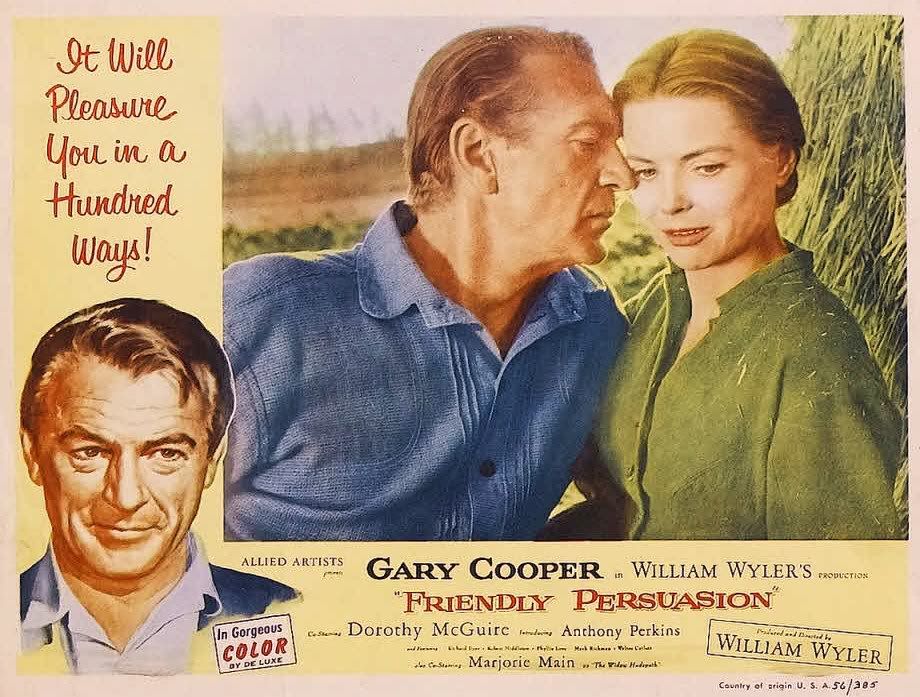
In 1955, Wyler had originally tried to cajole Katharine Hepburn to play the pious, bossy Eliza Birdwell, but the flinty actress proved elusive. His pursuit of a leading lady led to his pleading with Vivien Leigh who was committed to a season at Stratford-on-Avon, followed by Ingrid Bergman, who was the first choice of Gary Cooper. The refusal of the plum role by Bergman, whose detente with American blue noses would have to wait for her turn as Anastasia (1956), led the director to seek out a long list of actresses between thirty and fifty-five, including Maureen O'Hara, Jane Wyman, Eleanor Parker, Mary Martin, Martha Scott and Teresa Wright. At one point Jessamyn West found herself on the receiving end of Wyler's dead pan humor when he took her aside and asked with a straight face: "What do you think of Jane Russell? She's a very pious girl, I understand. Goes to church, teaches Sunday school, sings hymns."
 |
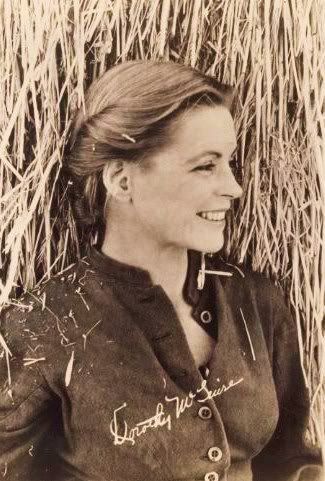
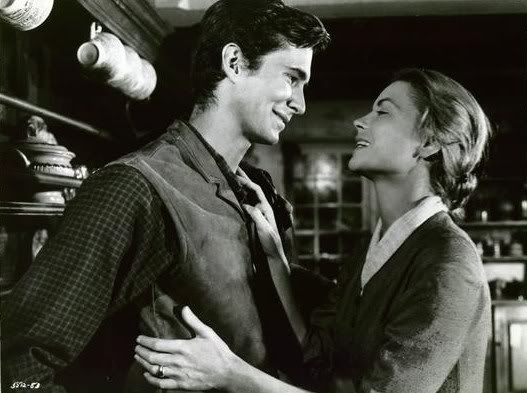
| Dorothy McGuire as Eliza Birdwell with Anthony Perkins as Josh Birdwell in Friendly Persuasion (1956). |
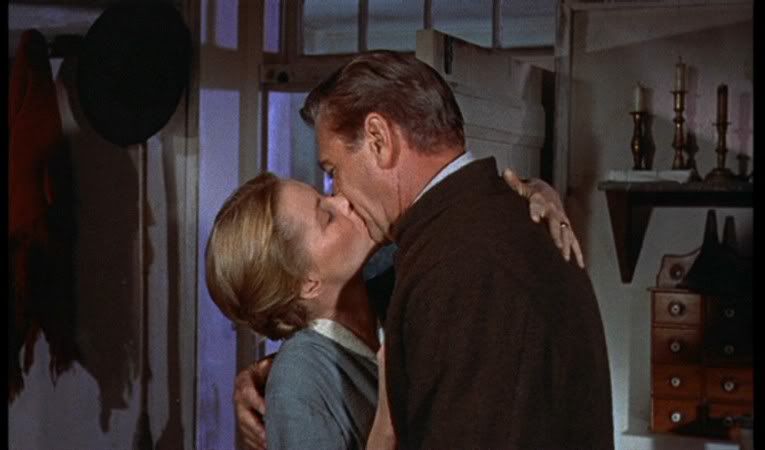
McGuire's spare beauty and the underlying latent girlishness gives her role as the often disapproving mother of three in Friendly Persuasion an appealing quality. Eliza Birdwell is the primary representative of Quakerism, a religion advocating pacifism, the equality of the sexes (McGuire's character is a leader of her sect), and an archaic speech using "thee" and "thou" for pronouns as a way to remain mindful of the sacredness in everyday life. Most audiences in the fifties and certainly now would find this manner of living rather rigid and alien. Despite the director and star's apparent dissatisfaction with their leading lady, Dorothy McGuire's portrayal of her strong character whose beliefs provide much of the story's conflict is important to the film. While she is firm in her views, Eliza Birdwell is humanized by an awareness of her own awareness of her fallibility and her love for her husband and son as they are drawn into the conflict as Confederates near their idyllic farm. (You can read several more posts on this blog related to Dorothy McGuire here).
 |
In the end, Perkins' pensive character, faced with the arrival of the Civil War on his doorstep, declares honestly that he does not know whether or not he
 |
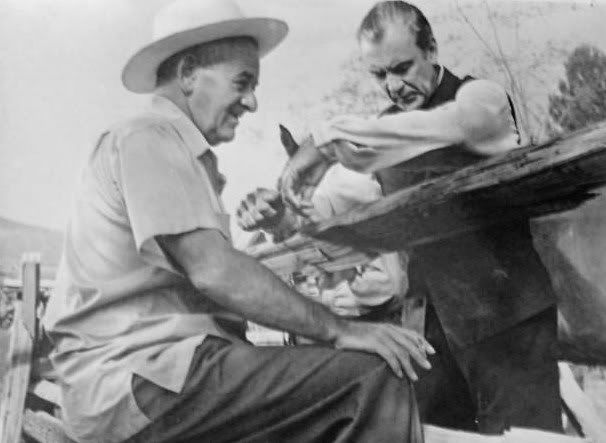
| Cooper and William Wyler discussing Friendly Persuasion on the set. |
My small quibbles with this movie, to tell the truth, are mainly with Samantha the Goose, who could have had a lot less screen time. I'd also have excised that icky Pat Boone song from the beginning of the movie!
*Mild Possible Spoiler Below**Mild Possible Spoiler Below*
According to Jessamyn West's memories of the film quoted from Jan Herman's William Wyler: A Talent for Trouble, the aging Cooper was reluctant to take the role of the conflicted Quaker patriarch, feeling that he wasn't well suited to play what he initially believed was a passive role. West, whose ambivalence about all of filmmaking comes through in her memories of this project, which was first developed by Frank Capra, recalled that at her first meeting with Gary Cooper, he explained to the author that "There comes a time when the people who see me in a picture expect me to do something."
"You mean pull a trigger?", West asked. Cooper reportedly replied, "Deliver a blow. First or bullet. Or sword. They expect it. They feel let down without it."
Wanting to know what his character would do in a way of action, Cooper asked Jessamyn West what "something" the writer might have him do as a Quaker.The occasionally impatient author replied: "Refrain. You will furnish your public with the refreshing picture of a strong man refraining." In the end, Coop picked up a gun as the conflict of the Civil War spilled onto his land and threatened to tear his family's world apart...but he did not fire.
Wyler allows the audience to get to know the family members and others in the community, using a nice blend of humor and pointed conversation. Anthony Perkins is quite touching as he communicates his torn response to the recruiting call of a Union soldier at a fair, even as he mother, Eliza Birdwell (McGuire) prays for pacifism and expects her children to adhere to her beliefs as well. The inherent conflict between a recognition of the existence of evil and a belief in pacifism has rarely been so eloquently expressed in a mainstream American movie.
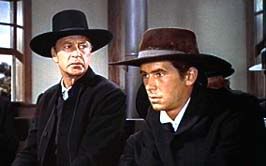
One of the story elements, dealing with the tug of violence on the oldest son (Anthony Perkins), and his father's own mixed feelings about the consequences of taking up arms reflects a thread that runs through the later films of Gary Cooper, several of which, including High Noon (1952), Man of the West (1957), They Came to Cordura (1959), and The Hanging Tree (1959), look at the corrosive nature of violence on the men who follow that path, and the nature of our perceptions of heroism. While Gary Cooper made many excellent films, I am quite fond of his work in this last decade of his life: Return to Paradise (1953), Love in the Afternoon (1957), Ten North Frederick (1958), and The Wreck of the Mary Deare (1959) each seems to have a rueful air about the squandered opportunities in the past, redolent with an elegiac air whenever the star is on camera. There is a haunted quality to Cooper's increasingly worn face that adds a depth of reality and feeling to each of his roles, even and especially in these sometimes less than ideal films.
 |
| Gary Cooper greeting Peter Mark Richman in Friendly Persuasion (1956) as Antony Perkins, Dorothy McGuire and Phyllis Love look on. |

Below is the trailer for Friendly Persuasion :
The Cast of Friendly Persuasion:
Gary Cooper...Jess Birdwell
Dorothy McGuire...Eliza Birdwell
Anthony Perkins...Josh Birdwell
Richard Eyer...Little Jess
Robert Middleton...Sam Jordan
Phyllis Love...Martha 'Mattie' True Birdwell
Peter Mark Richman...Gardner 'Gard' Jordan (as Mark Richman)
Walter Catlett...Prof. Waldo Quigley
Richard Hale...Purdy (violent Quaker)
Joel Fluellen...Enoch (black hired hand)
Theodore Newton...Maj. Harvey (recruiter in meetinig)
John Smith...Caleb Cope (wrestling Quaker)
Edna Skinner...Opal Hudspeth
Marjorie Durant...Pearl Hudspeth (pipe-smoking woodcutter in braids)
Frances Farwell...Ruby Hudspeth
Samantha the Goose...Herself
Marjorie Main...The Widow Hudspeth
For complete cast and crew, please visit here.
Sources:
Herman, Jan, A Talent for Trouble: The Life of Hollywood's Most Acclaimed Director, William Wyler, Da Capo Press, 1997.
Janis, Maria Cooper, Gary Cooper Off Camera: A Daughter Remembers, Harry N. Abrams, 1999.
Mirisch, Walter, I Thought We Were Making Movies, Not History, Univ of Wisconsin Press, 2008.
Meyers, Jeffrey, Gary Cooper: American Hero, Cooper Square Press, 2001.
"Twenty-Four Year Old Copy of Cooper," Life Magazine, July 16, 1956.
Thomson, David, Gary Cooper, Macmillan, 2010.
West, Jessamyn, Except for Me and Thee: A Companion to The Friendly Persuasion, Univ. of California Press, 2008.
Recommended Online Resources:
Jacqueline at Another Old Movie Blog has written an excellent review of this film :
http://anotheroldmovieblog.blogspot.com/2009/05/friendly-persuasion-1956.html
Gary Cooper at The Mave:
http://themave.com/Cooper/index.htm
The Gary Cooper Scrapbook:
http://garycooperscrapbook.proboards.com/
Jessamyn West: Quaker Author (1903-1984):
http://www.jessamyn.com/jessamyn/jess.html
William Wyler at Senses of Cinema:
http://archive.sensesofcinema.com/contents/directors/05/wyler.html


![[39+] Esstisch Aus Holz](https://lh3.googleusercontent.com/blogger_img_proxy/AEn0k_v13hAbCa8gjuWmE2iKzv1ix2ByhBkfjiyIIT4m7asWiKm21V2b6ndJRxOW16z2Gkjhzh5CJIxe65JUdmk-M5GBr4UfBrhpMXF5nawT3OPMavZ9DiM3AnfsRTbotooFeq75qsdlaCQvL4a0I9yJqPnlyYob8x0Vd8UZbCPaL4H7ALwGYCPn6WN3Phl-l7Q=w100)

0 Yorumlar